05 June 2025

My Facebook Page with Tips and News

I have a Facebook page where I share tips and news for those interested in family history. Unfortunately Facebook does *not* show all of those posts in your newsfeed. There have been times when they only showed a post to 2% of my followers!

You're more likely to see my posts if you...
  1. Add comments to my posts, share them, or click 'Like'; AND...
  2. Click 'Follow' on https://www.facebook.com/judy.webster.genealogy, and adjust your settings as shown in the image below.

You could also:
(This post first appeared on https://uk-australia.blogspot.com/2025/06/my-facebook-page-with-tips-and-news.html.)

12 August 2022

Genealogy Discounts and Freebies

Here are a few of the offers listed on the 'Genealogy Discounts and Freebies' webpage in August 2022. Links open in new windows.
  • 20% off Findmypast subscriptions (1 month or 12 month) if you pay via Findmypast's *Australian* site. The offer ends on 31 Aug 2022 at 11:59pm (BST). (See why I personally use and recommend Findmypast.)

  • Full transcriptions of New South Wales birth, death and marriage certificates are only $18 until midnight (AEST) on 31 Aug 2022.

  • 'Missing friends' records have information about people sought by relatives or friends; runaway children; eloping daughters; beneficiaries of wills; wife/child deserters; absconders from reformatories or from employment; suspected bigamists; people sought as witnesses to a crime; and various others. Until 19 Aug 2022 at 11:59pm (AEST), digital images of the original records are half price ($6 for one entry, and $4 for each additional entry). Check the 3 lists of names (A-G, H-O and P-Z).

  • Digital images from original registers of old age pension applicants are 50% cheaper if your request and payment reach me by 11:59pm (AEST) on 19 Aug 2022. If you email your request and quote 'code OAP.Aug2022', the discount price (for digital copies sent via the Internet) is just $3 for the first entry plus $2 for each additional entry - NOT the normal price shown on the webpages that list the 9,200 pension applicants' names.

  • You'll often find discount prices on books from my favourite online bookshop. Check whether they include any of the books on my 'genealogy/history recommended reading' list.
See also the other offers listed on Genealogy Discounts and Freebies.

(This post first appeared on https://uk-australia.blogspot.com/2022/08/genealogy-discounts-and-freebies.html.)

04 October 2020

40 Favourite Genealogy Resources

Image courtesy of Stuart Miles, FreeDigitalPhotos.net
I love using (and indexing) 'neglected' records that are great for overcoming brick walls in family history. Many have information about people from all over the world. You may be surprised to find your ancestors or their siblings mentioned in records held in distant lands!

These are some of the indexes and other resources that I regularly use to research families in Australia (especially Queensland, New South Wales and Victoria) and Britain, but many also have worldwide relevance. Links open in a new window. If a link doesn't work, check whether an updated version of this post is on my Website.

  1. Hospital Admission Registers. These superb records are usually more informative and more accurate than certificates. Sometimes they are the only surviving source with immigration details. Links lead to pages with source descriptions plus the names of over 12,500 patients (many born overseas). Note, in particular, the index to Croydon Hospital admission registers, which include the period of the local goldrush. In the 1880s-1890s about 70% of patients were born in Britain or Ireland, with smaller numbers from elsewhere, especially interstate and overseas mining areas.

  2. Mental Asylum records. If someone vanished, or if children were not raised by their mother, check mental asylum records. Many patients (including children) were only in an asylum very briefly, so you may not know about it. Some insanity files have superb information about the patient's relatives, and case books usually give reasons for admission and/or medical details.

  3. Old Age Pension records 1908-1909. The records include many people who were not on electoral rolls. Before you check the list of names (over 9,200 applicants, born worldwide, including many whose application was rejected), read the explanation of who was eligible for the pension.

  4. Files about repayment of fares 1929-1955. People signed an agreement, promising to repay the cost of a fare (usually interstate or overseas). This period includes the Great Depression, when many people travelled great distances in search of work. The list of names may include your relative who 'disappeared'.

  5. Police Gazettes. With information about victims of crime, offenders and many other people, these are a superb source for family history. Notices may give biographical data, immigration details, a physical description, and clues for research in other records.

  6. Court of Petty Sessions records. These have details of complainants and offenders, especially in minor cases. There are various types of CPS records. Indexes include some for Queensland, Victoria and Ireland.

  7. Police Watchhouse records (people arrested and victims of crime). Offences range from serious to minor, including 'being a neglected child'. This page explains the genealogical value of the records, with links to lists of names for various districts.

  8. Prison Records. Many people were imprisoned for minor offences such as having no lawful visible means of support. There are different types of prison records, and many are indexed. They include records for North Queensland, St. Helena (Queensland), Victoria and Ireland. Some New South Wales prison records are on Ancestry.

  9. Genealogical Index to Australians and Other Expatriates in Papua New Guinea. This covers a wide range of records, and it includes transcriptions of some that no longer survive.

  10. Registers of Maintenance Payments to Deserted Wives/Children. These often provide clues about men who 'vanished'.

  11. Trade Union Records. This collection has membership records for Australia, Belgium, Canada, Channel Islands, England, Germany, Gibraltar, Ireland, Isle Of Man, Malta, New Zealand, Rhodesia, Scotland, South Africa, Spain, Turkey, USA and Wales. Occupations include railway staff, carpenters, joiners, cabinetmakers, woodworkers, lithographic artists/printers, designers, engravers, boilermakers, iron shipbuilders, etc. Australian branches include Adelaide, Ballarat, Bathurst, Bendigo, Brisbane, Broken Hill, Charters Towers, Fremantle, Geelong, Hobart, Ipswich, Kalgoorlie, Leeton, Mackay, Melbourne, Mildura, Mount Morgan, Newcastle, Perth, Port Augusta, Port Pirie, Sydney, Townsville, Wollongong and others.

  12. Passport Records. There are records for people who were emigrating, or returning to their home country, or going overseas on holidays. I've included links re passport records in Australia and some other countries.

  13. Border Crossing Records. Thousands of Australians and New Zealanders are among those who crossed international borders between Canada, the USA and Mexico. Various series of records are on Findmypast and Ancestry.

  14. Ryerson Index. Extracts from death and funeral notices, and a few probate notices and obituaries, in Australian newspapers and on some funeral directors' websites. A great way to find exact death dates if you can't get them from Registrar-General's indexes.

  15. Trove. A free website with digital images of newspapers and other National Library of Australia resources.

  16. Queensland School Pupils Index. Compiled from school admission registers (in which you may find exact birth dates from less than 100 years ago), and published school and local histories.

  17. Statements by witnesses called before Queensland Government Committees. The witnesses were ordinary people from all walks of life (publicans, miners, labourers, seamen, farmers, graziers, railway employees, civil servants, etc). The index covers 1860-1920.

  18. National Probate Calendar. This includes people from all over the world, so don't be put off by its official title (Index of Wills and Administrations, England and Wales). I usually search the index for 1858-2019, then go to the Government site to order a digital copy of the will/probate record.

  19. Will Books. Wills for many people from other States and countries are included in New South Wales will books. Click 'Learn more' above the search boxes to find out more about the collection, and read my personal search tips.

  20. Brisbane City Council Cemeteries Search. The Council manages twelve cemeteries and three crematoria. Cemetery sites like this can reveal death dates that are too recent to be on the Registry of Births Deaths and Marriages website.

  21. Toowoomba Regional Council: Deceased Search. This covers nineteen cemeteries in the region. Search results link to headstone photos if applicable.

  22. Queensland Burials and Memorials. This database includes indexes to headstones in many Queensland cemeteries and lone graves, plus records of seven funeral directors. The total time frame covered is 1820-1996. Be sure to read 'Learn more' and 'What information can I find'.

  23. Gregson and Weight Index to Funeral Records 1972-2010. Records of funeral directors on Queensland's Sunshine Coast have details of burials and funeral services that took place not only in Australia but also in New Zealand, the United Kingdom, Ireland, Fiji, Sweden, Greece, Hungary, Austria and the Netherlands.

  24. Dern Index (published on CD-ROM by David and Julie Dern, c1999). This index summarises the main details on headstones in some Queensland cemeteries. If the CD is not in your local library, check whether the Queensland Family History Society has added it to their members-only online resources.

  25. Helen Harris's Historical Indexes. There are references to people from all over the world; and for research in Victoria (Australia) this site is a must. Indexes include missing people; wife/child deserters; criminal case files; Infant Life Protection Act indexes; Victoria Police; women lecturers; etc.

  26. Passenger lists to Australia 1897-1963. Passengers en route to other ports (eastern States etc) are included in an indexed collection (on Ancestry) for 1897-1963 ship passenger arrivals, crew lists, air arrivals and quarantine lists for Fremantle, Western Australia.

  27. Index to Sydney Benevolent Asylum records 1857-1900. Many people from interstate are in these records. Some went to Sydney to 'hide' the birth of an illegitimate child.

  28. Sydney Anglican Parish Registers 1814-2011. Baptism, burial, confirmation, marriage and composite registers. When I can see an image of the marriage register, I don't need to buy the marriage certificate!

  29. Alphabetical Index to Newspaper Cuttings 1841-1987. Most of the records are for New South Wales, but a few are from Queensland. The cuttings are mainly for marriages and deaths, but a few are for births or the 1811 census.

  30. Government Gazettes. They contain a vast amount of historical and genealogical information about ordinary people. Many Government Gazettes are on Findmypast. Read 'Search tips' (if they exist) before you search.

  31. Civil Service Evidence of Age records. There is information about people from around the world (including 654 from Australia and New Zealand) although the records are primarily British. I've found exciting details (especially for people whose birth was never registered) in images in this record set. Click the right arrow to see the next related image, which is often a baptism record.

  32. Great Western Railway Shareholders. Although most events relate to residents of England and Wales, the shareholders, executors, beneficiaries and others include people from Scotland, Ireland, Australia, and other countries. The image often has death/burial details, occupation, address, names of other parties, marriage date etc.

  33. Historical Photos or Sketches of People (from public records that most people overlook). Photos/sketches are accompanied by information that is superb for family history. More names will be added as indexing progresses.

  34. Records that name the father of an illegitimate child. If his name is not on the birth certificate, there are other places to look. I've indexed many different record series, and more names will be added in the future.

  35. Missing Friends records. The people sought include emigrants, missing relatives, eloping daughters, wife/child deserters, women who abandoned a child, missing beneficiaries of wills, suspected bigamists, etc. Stage 1 of the index is online (spread over 3 pages, with about 8,000 names yet to be added).

  36. Yorkshire Collection. The largest online collection of Yorkshire records! I've had great success with this, and millions more records (including images of original parish records) have been added in recent years. Search each record set separately. Highlight/copy the results list, paste it into a spreadsheet, study the results, then view any images that may be relevant. Look at the transcription too, because it usually has the source citation.

  37. London Metropolitan Archives collection. Indexes and images of parish registers for most of the Greater London area (which includes parts of Middlesex and Surrey), plus wills, school and electoral records, etc.

  38. British Nationals overseas. There are separate indexes for births, marriages and deaths (including deaths at sea). While researching my British ancestors and their siblings, I was surprised to find births and marriages in China and Canada.

  39. Society of Australian Genealogists 'Manuscript and Image Collection'. Family papers, unpublished research notes, pedigrees, photographs, certificates etc from Australia and overseas, with a searchable catalogue. Without this I would never have traced my WEBSTER family in London.

  40. Postems on FreeBMD. This shows how you can use Postems on free civil registration indexes for England and Wales to get extra details or contact distant relatives.

See also 'Other indexes for Queensland Genealogy'. Some are online, and others are in libraries or other record offices.

(This post first appeared on https://uk-australia.blogspot.com/2020/10/40-favourite-genealogy-resources.html.)

14 August 2020

Unusual Way to Find a Maiden Surname

Image by Stuart Miles, freedigitalphotos.net
This is how I discovered the maiden surname of Bertha Gladys, wife of Ernest Tasman WOOLDRIDGE:
  1. Libraries Tasmania's online collection: Tasmanian Archives item number HSD274/1/3, New Town Infirmary alphabetical admission register, says 'Bertha Gladys WOOLDRIDGE born Blayney NSW'.

  2. Tasmanian Archives online catalogue entry: item number HSD186/1/5696, refers to Bertha Gladys WOOLDRIDGE born 21 Oct 1892 (but further research showed that this should be 1891).

  3. Ernest Tasman WOOLDRIDGE's will (which is online) refers to 'May Alva GARLICK, the sister of my late wife Bertha Gladys WOOLDRIDGE'.

  4. New South Wales Registar-General's births index has entries for Bertha G. GARLICK (born 21 Oct 1891) and her sister Mary A. GARLICK, parents John and Elizabeth, district Blayney.

Ernest's parents are William Tasman WOOLDRIDGE and Helen Rebeccca CAMPBELL, and I'd love to hear from their descendants. Helen is my great-great-grandmother's sister. Many of the WOOLDRIDGE family were in Tasmania, but Archibald Edward WOOLDRIDGE moved to Queensland.

Forty-five trees on Ancestry had the wrong information for Bertha. They said she wasn't married, and that she died in 1974 (she actually died in 1954). I guess one person's tree was wrong, and forty-four people copied it without checking the facts. Sigh.

Postscript, 2024: For more ideas, see (these open in new windows): (This post first appeared on https://uk-australia.blogspot.com/2020/08/unusual-way-to-find-maiden-surname.html.)

06 January 2020

Why I Recommend LostCousins.com

LostCousins logo
LostCousins.com is probably the only web site that identifies (with virtually 100% accuracy) people who share the same ancestors. You do not waste time corresponding with people who are not related to you! I have found several new relatives here; and the free email newsletter has lots of useful tips.

To use LostCousins you need to find your relatives in the census for England and Wales 1841, 1881 or 1911; Scotland 1881; Ireland 1911; United States 1880 & 1940; Canada 1881; or Newfoundland 1921 (and access to seven of those censuses is free). Then at LostCousins, enter the census source/page details for those names. Before gathering and entering data, read the instructions carefully, because requirements for each census are different. If you prepare well, entering the data is a lot quicker. From the LostCousins home page, go to 'Census links' and 'Information - Read this first'.

Be sure to enter data for brothers and sisters of your direct ancestors, because it is their descendants who are the 'cousins' you want to contact.

After entering some relatives, click 'Search', and the system checks whether someone else has entered identical data. Remember to log in periodically, go to your 'My Ancestors' page and repeat the search.

It is FREE to join LostCousins and enter your data, but I choose to pay a small annual subscription (about $10) so that there are no restrictions on contacting my distant cousins when they are identified by the extremely accurate matching system.

The more people who enter census data for direct ancestors and their siblings, the greater the chances of finding our 'lost cousins'. Maybe you are my distant relative! I want to find you - so please... start adding your ancestors and other relatives to LostCousins!

(This post first appeared on https://uk-australia.blogspot.com/2020/01/why-i-recommend-lostcousinscom.html.)

15 August 2019

Why we enjoyed DNA Down Under (genealogy conference)

If you're interested in why and how I've used DNA tests as a tool for family history, see this page (it opens in a new window).

Yesterday's DNA Down Under conference in Brisbane (which will be followed by similar events in Perth, Adelaide, Melbourne, Canberra and Sydney) was a great success. I found it enjoyable, informative and inspiring, and I now feel even more enthusiastic about using DNA as a tool for family history. The conference also gave me a chance to chat to friends and clients... and, as a bonus, I met the wife of one of my DNA matches!

If you're going to DNA Down Under, you're in for a treat. On a scale from one to ten, Blaine Bettinger (the keynote speaker) is definitely a ten. He explains what you need to know to get started with DNA, and how to make the most of your results, but he does not overwhelm beginners with scientific details that they really don't need to know.

If any of my DNA matches were amongst the audience, I hope they were paying close attention when Blaine explained the benefits of adding a surname list and 'earliest known ancestors' in FamilyTreeDNA (under 'Account settings - Genealogy'). He also encouraged us to link at least a 'skeleton' family tree to our DNA results at each testing company. At AncestryDNA, I'd linked a tree that is private but searchable - and that does allow me to use 'Thrulines' and other features... but I now intend to link a smaller 'skeleton' tree, showing names, dates and birth places for my direct ancestors, and I will make that tree public.

This is what one of my clients (Keith) said about DNA Down Under:
The day was a real eye-opener for me. I've had DNA done - first by Ancestry and 23andMe and most recently by FamilyTreeDNA and still waiting for LivingDNA. However, I've done little with the results. Yesterday was excellent for opening my eyes to how to use DNA as part of a structured investigation of problems and hypotheses. I have also booked for the 3-day event in Sydney. Blaine is not only a great speaker but completely on top of his subject. It was a great day.

Note that the Sydney programme includes many talks that are different from those in the other five cities. Programmes and speaker profiles for each city are on the DNA Down Under web site.

(This post first appeared on https://uk-australia.blogspot.com/2019/08/why-we-enjoyed-dna-down-under-genealogy.html.)

21 July 2019

How I Found Sarah Sheppard's Parents

Over the years I've worked long and hard to trace descendants of my direct ancestors' siblings, and my efforts have been richly rewarded. On five occasions those descendants had very old family documents that have smashed through 'brick walls' in my family history.

My most recent success was the result of a DNA test. Because I'd traced side branches of the family from about 1800 right down to the 1980s, I could see that one of my DNA matches is a third cousin once removed. I contacted John and offered to exchange information. (I'd written to his mother thirty-six years ago, but she didn't reply, and I'd lost track of that line.)

I knew that my ancestor Sarah SHEPPARD, born in 1762, married Richard GIBLETT in Frome, Somerset, England. Imagine my excitement when John sent me photos of a bible (published in 1736) in which are written SHEPPARD family names and dates, mainly from the 1700s! The bible entries show (among other things) that Sarah's father was Benjamin SHEPPARD, and that he was married on 1st October 1746.

In the magnificent London Metropolitan Archives collection, I found an image of a parish register that says Benjamin SHEPPARD married Elizabeth BEEX on 1st October 1746. [London Metropolitan Archives ref. P91/LEN/A/008/MS07498/001, Saint Leonard, Shoreditch, Middlesex.]

Screenshot showing ancestors of Elizabeth Beck Webster
Ancestors whose surnames were used as middle names
I suspect that Elizabeth's surname may actually have been BECKS or BECK. My family has a document written in the late 1800s that says, 'Our maternal ancestor's maiden name was BECK.'

The family also had a habit of using ancestral surnames as middle names; and great-grandchildren of Benjamin SHEPPARD and Elizabeth BEEX include Elizabeth Beck WEBSTER, Elizabeth Sheppard WEBSTER, Richard Giblett WEBSTER, James Porter WEBSTER and George Harley WEBSTER. I had previously identified the origin of middle names Sheppard, Giblett, Porter and Harley. Perhaps this latest discovery explains Beck.

The family bible includes Benjamin's death date, and I found a burial register entry for him in Frome, Somerset.

Without the names and dates in the SHEPPARD family bible, I may never have identified the correct family. Tracing descendants of all of your direct ancestors' siblings, and contacting those descendants, is a research strategy that I highly recommend. It has worked well for me on many occasions. Give it a try!

(This post first appeared on https://uk-australia.blogspot.com/2019/07/how-i-found-sarah-sheppards-parents.html.)

08 June 2019

Why I'm going to DNA Down Under

2 cities
I've made a lot of progress since I first wrote about my plans to use DNA tests as a tool for family history research. Although I was interested in finding out whether my 'ethnicity estimates' contained any surprises, my main reasons for using DNA were (1) to confirm or disprove relationships that seemed likely (based on my traditional research), and (2) to put me in contact with others who share the same ancestry.

My parents died before DNA tests became affordable, so in 2012 my 91-year-old uncle agreed to have his Y-DNA, mitochondrial DNA and autosomal DNA tested. Tests for autosomal DNA are the most popular with family historians, because they have the potential to identify descendants of all ancestral lines (maternal and paternal) within about the last six generations. Autosomal DNA is inherited (by both males and females) from mother, father, four grandparents, eight great-grandparents, etc.

It was important to test my uncle, not just myself, because that gets me a generation further back when looking for ancestors in common with his matches. The more relatives who are tested, the more useful the results will be. I can now compare my uncle's DNA with that of his nephew, two nieces, and fifteen other known relatives ranging from a first cousin once removed to a fifth cousin once removed. That data has helped me to work out how some of his other DNA matches must be related. To do that, though, it is usually necessary to know the start and end points of matching chromosome segments. Annoyingly, that information is not provided by AncestryDNA - so I persuaded relatives who tested there to either test with, or transfer their AncestryDNA raw data to, FamilyTreeDNA, who provide a very useful Chromosome Browser.

I started with my uncle (who has since passed away), but I've also had my own DNA tested at FamilyTreeDNA, AncestryDNA and LivingDNA, and I've uploaded my data to MyHeritageDNA and Gedmatch. Other links that I found helpful are on my Web site.

Thanks to DNA results, I've contacted dozens of previously unknown relatives (DNA matches) who have shared their knowledge with me. Some even had letters written by my direct ancestors! Although I've already made progress, I know that I could make better use of all the tools that are now available to help us analyse our DNA data. There's lots more to learn, and that's why I'll be attending 'DNA Down Under'.

'DNA Down Under' is a world class DNA-themed conference and road show featuring respected genetic genealogist Blaine Bettinger. The August 2019 events in Brisbane, Perth, Adelaide, Melbourne, Canberra and Sydney will include topics suitable for all levels (beginner to expert). The Sydney programme is almost entirely different from those in the other five cities. You can go to your city's page and book the two-city bundle at $30 off the price of booking the two cities separately. The admission cost includes a light lunch, morning tea and afternoon tea/coffee.

If you have not done a DNA test and want to know how it can help with your family history, or if you have tested but are unsure how to make the most of your results, 'DNA Down Under' is for you!


(Disclosure: As an appointed DNA Down Under 'ambassador', I receive free admission to the one-day event in Brisbane... but I would have booked a seat even if I had not been offered a free ticket. #DNADU)

(This post first appeared on https://uk-australia.blogspot.com/2019/06/why-im-going-to-dna-down-under.html.)

24 May 2018

More parish registers for Kent, England, will go online

Saint Mary's Church, Hinxhill, Kent (photo by Barry Marsh)
Photo by Barry Marsh
For the county of Kent (England), thousands of fully indexed images of original Anglican parish records (baptism, banns, marriage and burial registers from the early 16th century up to 1918) will be made available online for the first time, exclusively at Findmypast.

The first records will be published later in 2018. In addition to using the search function, we will be able to browse the images page by page.

Once fully digitised and indexed, these new additions will join Findmypast's Canterbury collection and existing collections of Kent Family History Society records to form the world's most comprehensive online repository of Kent parish registers.

To find out what Kent records are currently online, go to the full list of UK records on Findmypast and search for the word Kent.

(This post first appeared on https://uk-australia.blogspot.com/2018/05/more-parish-registers-for-kent-england.html.)

28 November 2017

Major Changes at Findmypast

(Megaphone image by Stuart Miles, FreeDigitalPhotos.net)
Today Findmypast announced that they are now offering customers the opportunity to sign up to three new package tiers (Starter, Plus and Pro) - and the 1939 Register is (for the first time) available to monthly subscribers to the Plus and Pro packages.

All three options (Starter, Plus and Pro) aim to simplify Findmypast's offerings for the UK market. They have been specifically tailored to family historians. Whether they are looking for a simple way to begin exploring their family history, to take existing research further or to uncover detailed facts about the lives of their ancestors, customers will be provided with access to the records they truly need at each stage of their research.

The 1939 Register is now available to monthly subscribers for the first time; and both 'Plus' and 'Pro' subscriptions include unlimited access to that wartime 'census'. This essential resource, only available online through Findmypast, plugs a vital 30-year gap in British records, and it is the only surviving record of the civilian population of England and Wales between 1921 and 1951.

The new subscription options include:
  • Starter package to help beginners on their journey. This offers the simplicity of starting with essential birth, marriage, death and census records, and it includes full access to Findmypast's family tree hinting system, allowing users to quickly trace their family's story back to 1837. As it's designed specifically for beginners, the package also includes Findmypast's search functionality, support content, live chat and instant help - and all new subscribers will receive a free Getting Started guide. Prices: £8.95 per month or £72 per year.

  • Plus package with 1939 and all the essentials for the keen hobbyist. This is designed for those wanting to take their research to the next level - which is why, for the first time, Findmypast has included the 1939 Register in a monthly subscription. This unique record set will now be available to even more members of the genealogy community, enabling more people than ever before to discover their civilian ancestors in England and Wales at the start of World War 2. Beyond the 1939 Register, all parish, military, education, institutions and social history records as well as all electoral registers, directories, and travel and migration records will help Plus subscribers delve deep into their family trees. Prices: £12.95 per month or £120 per year.

  • Pro package to bring the serious genealogist's research to life. This package contains everything the serious or professional genealogist needs to explore the lives of their ancestors in detail. It includes access to all of Findmypast's global record sets and advanced resources such as PERSI, the 1939 Register, and the largest online collection of British and Irish newspapers in the world. And with priority customer support, exclusive Webinars and advanced education aimed at experienced genealogists, Findmypast will help Pro subscribers expand their research every step of the way. Prices: £15.95 per month or £156 per year.

I've had a World subscription to Findmypast for many years. It will be interesting to see what proportion of new subscribers choose each of the three subscription packages.

(This post first appeared on https://uk-australia.blogspot.com/2017/11/major-changes-at-findmypast.html.)

31 January 2017

Australian Electoral Roll Indexes, and Who Could Vote

You can do either a name search or an address search in the Australian electoral rolls collection at Findmypast.

More rolls may be added in the future, but right now (UPDATED 13 Jan 2021) Findmypast lists these as available:
  • Queensland:  State electoral rolls 1860-1884 and 1895-1915, and Commonwealth electoral rolls 1903, 1906, 1913, 1922, 1934, 1941, 1949 and 1959. Only 45% have images of original rolls, but transcriptions for 1860-1884, 1903, 1913, 1922, 1934, 1949 and 1959 are very useful.

  • New South Wales:  State electoral rolls 1903 and 1913, and Commonwealth electoral rolls 1935. 100% have images.

  • South Australia:  Commonwealth electoral rolls 1939, 1941 and 1943. 100% have images.

  • Western Australia:  Commonwealth electoral rolls 1939, 1943 and 1949. 100% have images.

  • Tasmania:  Commonwealth electoral rolls 1916, 1934 and 1943. 66% have images.

  • Northern Territory:  1895, 1906, 1922, 1928, 1929, 1930, 1931, 1934, 1937 and 1940. No images.

  • For Victoria, first read 'Search Tips', because the records are PDFs.

Index searches are free. To see transcriptions or images of original records, I recommend either a one-month or twelve-month subscription.

* Who could vote *

Details below are derived from Electoral Pocketbook (Commonwealth of Australia, 2005).
  • 1901:  State franchises applied at the first federal election (NSW, VIC, QLD, TAS men over 21 years; SA and WA men and women over 21 years). Enrolment and voting were voluntary.
  • 1902:  Most men and women over 21 years were allowed to vote at federal elections. However, Aboriginal natives of Australia, Asia, Africa or the Pacific islands except New Zealand were excluded from enrolment and voting unless they already had the franchise at State level. Women over 21 years were allowed to vote in NSW elections.
  • 1903:  Women over 21 years were allowed to vote in TAS elections.
  • 1905:  Women over 21 years were allowed to vote in QLD elections.
  • 1908:  Women over 21 years were allowed to vote in VIC elections.
  • 1911:  Enrolment (but not voting) became compulsory.
  • 1915:  Queensland introduced compulsory voting in State elections.
  • 1920:  Nationality Act 1920 gave British subjects all political and other rights, but South Sea Islanders were still unable to vote despite being British subjects.
  • 1924:  Voting at federal elections became compulsory. Enrolment had been compulsory since 1911.
  • 1925:  Natives of British India living in Australia were allowed to vote.
  • 1949:  Aboriginal people were given the right to vote at federal elections provided that they were entitled to enrol for State elections or had served in the Defence Forces.
  • 1962:  All Aboriginal people became entitled to enrol and vote at federal elections.
  • 1973:  Qualifying age for enrolment for federal elections was lowered from 21 years to 18 years.
  • 1984:  Enrolment and voting for Aboriginal people became compulsory. Franchise qualification changed to Australian Citizenship (but British subjects on the roll immediately before 26 Jan 1984 retained enrolment rights).

Queensland has four separate series of electoral enrolment records. Differences and advantages are explained on Queensland Genealogy and Archives Research Tips. (In the future, this page is likely to have the latest updates and links for electoral rolls - eg, the 1969 Commonwealth electoral roll for Queensland.)

This is the address search screen at FindMyPast.


If you can't find someone in the Australian electoral rolls collection at Findmypast, check (on that page) the list of records included in the collection at that time, and (above) the legislation regarding who could enrol to vote. You should also try the electoral rolls on Ancestry.

I've seen a case where a man used his real name on State electoral rolls and a completely different name on Commonwealth rolls. I only discovered that after I saw the alias mentioned in his Supreme Court probate file.

In the future, you're likely to find more recent information about electoral rolls in Queensland Genealogy and Archives Research Tips.

(This post first appeared on http://uk-australia.blogspot.com/2017/01/australian-electoral-roll-indexes-and.html.)

27 September 2016

Wiltshire Baptisms (Tuesday's Tip)

GIBLETT baptism extract
Extract from Findmypast's transcription for the 1748 baptism of Sarah GIBLETT
This posted was updated in August 2017 after more entries (for dates up to 1917) were added to the index.
--
If you're looking for baptisms in the county of Wiltshire (England) between 1530 and 1917, start by searching the record set Wiltshire Baptisms 1530-1917 at Findmypast.

The transcriptions there (created by the Wiltshire Family History Society and by Findmypast) give some details (such as notes about parents' residence in a different parish) that are not shown in Wiltshire baptism transcriptions on Ancestry.

The illustration shows part of the entry for Sarah GIBLETT, whom I suspect may be a sister of my 4xgreat-grandfather Richard GIBLETT.

If you're researching any GIBLETT, HYDON or HINWOOD family with connections to Warminster (Wiltshire) or Frome, Glastonbury or Shepton Mallet (Somerset), I'd love to exchange information with you. My email address is in the sidebar here.

('Tuesday's Tip' is a theme used by 'Geneabloggers'. This post first appeared on http://uk-australia.blogspot.com/2016/09/wiltshire-baptisms-tuesdays-tip.html.)

01 April 2016

Will Books 1800-1952

Archives in a particular region usually hold wills or probate records for many people who lived or died in other regions. That's why I deliberately chose not to mention a location in the title of this post.

I've found an amazing amount of information about people in other States and even other countries in NSW Will Books 1800-1952. Countries mentioned include England, Scotland, Ireland, Wales, New Zealand, Canada, USA, South Africa, Germany, Fiji, Mexico, India, Holland, China, Papua, New Guinea, etc.

The original books are held by State Records New South Wales. Before 1924 they contain handwritten copies of the wills. Between 1924 and 1952 the copies were typed.

Images of the Will Books are on FindMyPast. Searches are free (you only pay if you want to see an image or transcription). My search tips are shown below. Start with strategy no.1, then try no.2, and so on.
Search screen for NSW Will Books 1800-1952
  1. Search for a name in 'Who' (you can use asterisks as wildcards). 'Death year' is optional, and you can select 'give or take' (+/-) up to 40 years. For now, ignore the 'Residence' field.

  2. In the separate field called Heirs' or executors' last name, enter a surname (you can use asterisks as wildcards), but leave both of the Who fields empty.

  3. If you use the Residence field, use wildcards. You'll understand why if you search for *Brisbane*, with asterisks before and after, and note the residences shown in results! Data in the Residence field is not entered in any set format. It may be just a town, or just a State, or just a country, or town+State, or State+country, etc (with or without punctuation, which makes a difference to the results). Sometimes places are abbreviated (eg, Queensland / Qld).

  4. Experiment with other variations and combinations. Keep a list of the search criteria that you use, because you may later think of other ways to search.

  5. When you use the Heirs' or Executors' Last Name field, be aware that the results may be incomplete. For example, you won't find heirs and executors of Julia COUTTS because (although they are shown in her Will Book entry) the names have not been included in the transcription. Presumably you could add them to the database by clicking 'Report an error in this transcription' and entering the names in the appropriate fields.

  6. It is essential to view images of the original Will Books, because a 'transcription' does not include the will itself.

  7. Click 'Learn' above the search boxes to find out more about the collection.

Although only a few of my ancestors were in New South Wales, I've already found fifteen wills - and that's just from random searches 'off the top of my head'. Imagine what I might achieve if I get organised and do systematic searches in Will Books 1800-1952!

(This post first appeared on http://uk-australia.blogspot.com/2016/04/will-books-1800-1952.html.)

I use and recommend...
Findmypast

25 February 2016

Why I Use and Recommend FindMyPast

Updated 16 Sep 2019

I am a big fan of Findmypast for genealogy research. For records that are also on other sites, Findmypast's indexes and transcriptions are (in my experience) more accurate (and this is particularly obvious with British censuses). I also love the fact that Findmypast lets us sort the search results. Searches are free, so give it a try!

Findmypast includes an especially good collection of Queensland records, and I have also been using their British census records and parish registers for many years. Recently I made exciting discoveries in NSW will books 1800-1952 (which include information about many non-NSW people), passenger lists, Royal Household records, the 1939 Register, East India Company and civil service pensions, and non-conformist baptisms, marriages and burials. For example, UK outwards passenger lists showed that between one British census and the next, some of my families went to South Africa and Canada and then returned to England.

See the updated version of my article Why I Use and Recommend Findmypast, which highlights some of the most outstanding features of the site.

Findmypast

31 January 2016

CuriousFox (gazetteer and genealogy message system)

Logo on www.curiousfox.com
CuriousFox is a gazetteer and message system that connects genealogists and local historians. Collaboration between these two groups is immensely beneficial.

In CuriousFox, every town and village in the United Kingdom and Ireland has its own page. There is also a USA version, which I have not personally used.

Things I like about CuriousFox include:
  • Exact map locations and historic maps.
  • Free to join, add entries, and search by village or surname.
  • With surname searches, finding relevant entries is easier because you can work at town / village level.
  • You can search for 'nearby' entries.
  • It is easy to edit or delete your entries.
  • Google searches will find your entries (so 'new relatives' can contact you).
  • No spam (your email address is not visible).
  • Privacy (the system sends messages between members, and you decide whether to give a particular member your address).
  • Advantages of being a paying member (about six pounds per year) include:
    • Contact and be contacted by all other members (free or paying).
    • Receive email alerts when people add entries for towns of interest to you.
    • Publicise your Web page or blog.

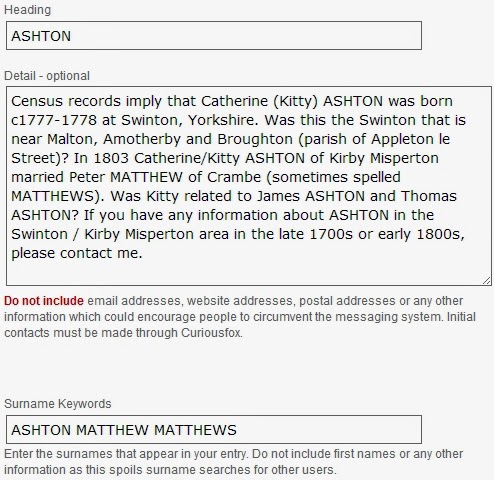
Entry screen for my ASHTON message
HINTS:
  • Give some thought to the wording of your entries. They should be concise, with surnames (and only surnames) in capital letters. Specify dates, and use appropriate punctuation.

  • For large towns with many entries and multiple pages, delete your entry every year and immediately resubmit it (updated if necessary) so that it reappears near the top of the list for that town. I did this recently, and within 24 hours a local historian contacted me and offered to send transcriptions of land records for that surname/town!

I hope you will try Curious Fox and share your success stories in a comment here.

(This is an updated version of a post that originally appeared on http://uk-australia.blogspot.com/2010/08/curiousfox-follow-friday.html for 'Follow Friday', a theme used by 'Geneabloggers'. I also published it on http://worldwidegenealogy.blogspot.com/2014/08/curiousfox-gazetteer-and-message-system.html.)

01 December 2015

Postems on FreeBMD (England and Wales)

This is an updated version of a post that I originally published here in August 2010. It is also one of my contributions to 'Worldwide Genealogy: a Genealogical Collaboration'.

FreeBMD is an ongoing project to transcribe civil registration indexes of births, marriages and deaths for England and Wales, and to provide free Internet access to those transcribed indexes. FreeBMD is an immensely useful site, and I like it even more since it produced the unexpected bonus of contact with new relatives via 'postems'.

An excellent feature of FreeBMD (but one that is overlooked by many genealogists) is the ability to add a postem (a short message, 250 characters maximum) to any entry in the FreeBMD database.

The postem can tell people how to contact you - or if you buy a certificate that turns out to be for the wrong person, you can help other researchers by putting details from the certificate in a postem.

Here is a step-by-step example of how I used a postem.

I searched FreeBMD for the birth registration of Bertha OAKLEY, who (according to census records) was apparently born in 1895 in County Durham. This is the search screen.


The search result looked like this.


I clicked the 'Info' icon and added a postem with my contact details.

When someone adds a postem, an envelope icon appears beside the entry, as shown below. You click the icon to read the postem.


To my delight, a distant relative contacted me as a result of my postem! She had information about Bertha OAKLEY's grandfather, Benjamin PEACOCK, who was a brother of my great-grandmother, Mary HUDSON nee PEACOCK.

This was just one of several similar successes that I've had with FreeBMD. I now always add a postem for each index entry that is (or could be) for my family... and I need to go back and add some that I didn't do originally.

I also use the 'search postems' feature to quickly check whether anyone else has added one that may be relevant to me. Here is an example of a search...


...and the search result, showing two postems that fit the criteria.


If you have used FreeBMD to find births, marriages and deaths for your family, I urge you to:
  1. Go back and add postems to all of those entries.
  2. Include an email address that will be valid long-term, such as a free Gmail address from Google.
  3. Check the text carefully before you click 'create', because postems cannot be changed or deleted.
  4. Before you start, read the Postems Help page.

~~~
I use and recommend...
Findmypast

24 November 2015

10 Tips for Wills, Intestacies and Probate

Cover of a probate file (Queensland)
52 Weeks of Genealogical Records: Week 3 (Wills, Intestacies and Probate)

These tips demonstrate why I recommend that you look for wills for every person in your family tree. [UPDATE: From 2019 to 2025, a copy of a will/probate record for England and Wales from 1858 onwards cost only £1.50. It has now reverted to a much higher price.]

Probate records, wills, intestacies, administrations and related documents are vitally important for family history. They provide clues for further research, and they 'put flesh on the bones' as we research our ancestors. They often have relationship details that prove whether we are researching the correct person or someone else with the same name.

Tip 1.  Use indexes for other States and countries.  There may be copies of a will or related documents in multiple places, including record offices far away from where the person died.  Examples:
  • Magdalene NIELSON:  Formerly of Bundaberg, Queensland, Australia, but late of New York, USA; wife of Peter NIELSON (formerly of Bundaberg but at present of Copenhagen, Denmark). The Supreme Court file at Queensland State Archives includes Magdalene's death certificate from America (giving her age, marital status, occupation, birthplace, how long in USA, how long in New York City, names and birthplaces of her father and mother, her place and cause of death, and class of dwelling); and a transit permit for her body to go to Germany, stating the exact burial place there.

  • Ellis READ:  He owned land at Burketown, Queensland, Australia; and when it was sold, a grant of probate was required so that a certificate of title could be issued. His Supreme Court file at Queensland State Archives shows that he lived in Mexico from 1882 to 1890; and between 1887 and 1890 he make business trips to England and lived there for a few months at a time. He died in Mexico in 1890. An affidavit gives a translation of details from his death certificate (age, cause of death, burial place, native place, occupation, wife's maiden name, father's name, mother's maiden name).

  • Julia WEBSTER (my great-great-grandmother):  Probate was granted in New South Wales, and I found her will in New South Wales will books 1800-1952; but there are also documents at the Public Record Office of Victoria (PROV) because Julia had property in both States. She lived in NSW but was entitled to a share of the estate of her late brother, Malcolm John CAMPBELL, in Victoria. (The PROV files include extra documents, and I was able to download digital copies free of charge.)

  • Some of the other tips below give more examples of finding information in records of another State or country.

Tip 2:  Probate files may include birth, death and marriage certificates.  The death certificate in a probate file is usually more accurate than a typed certificate that was issued later, and sometimes it has extra or significantly different details (examples are in Free Certificates in Archives Files.) Probate files often contain certificates that would otherwise be restricted and/or expensive!
  • Some probate files contain birth, baptism, marriage or death certificates because beneficiaries had to prove their relationship to the deceased.

  • From about the mid-1890s onwards, most Queensland Supreme Court probate files (and some intestacy files) contain a death certificate. The majority of these files are at Qld State Archives and have no access restrictions, so you can see very recent certificates. Photocopies cost about $1 per page, but if you take digital photos or copy from microfilm to a USB drive, there is no charge. It is worthwhile looking for files for your direct ancestors, their siblings and other relatives.

Tip 3:  Some wills are only in land title records.  If a person died without a will, his/her relatives would need to prove their relationship before the deceased's land could be transferred to them. The Titles Registry in Queensland holds many records of intestate estates, and many wills that did not go through the Supreme Court.  Examples:
  • The Titles Registry has a large packet of documents for a particular person (name withheld at my client's request), including seven certificates for births, deaths and marriages of various family members.

  • Indexes to Transmission of Real Estate by Death 1878-1940, from Queensland Government Gazette notices, include all names mentioned. Many property owners and claimants lived interstate or overseas. For a detailed description of the index and original records, see the book Tips for Queensland Research.

Tip 4:  Probate files may give parents' names when death certificates don't.  Example:
  • Margaret STAPLETON:  Her death certificate in Queensland, Australia, says 'born Ireland, parents names unknown'; but her probate file at Queensland State Archives reveals their names. In her will, Margaret left property to her sister Johanna in Ireland. As Johanna's surname was spelt incorrectly in the will, she had to prove that she was the person named as beneficiary. Johanna was unable to supply her birth certificate because her birth had not been registered. Instead she sent a copy of her baptism record from a parish register in England! It gave her father's name and mother's maiden name.

Tip 5:  There may be a delay, or there may be two separate probate files created many years apart.  Examples:
  • A second file was sometimes created because one of the deceased's children later applied for guardianship of younger siblings.

  • Abraham ALMAN of Melbourne, Australia, died in 1854. Twelve years later, administration of his estate was granted (in the United Kingdom) to his widow, who had since remarried and was living in Middlesex, England.

  • See Tip 10 for more examples of probate being granted decades after the death.

Tip 6:  Read before you research.  Look for published guides and search procedures, which Archives and Record Offices often put on their Web sites. If you don't understand how the records are arranged, you may fail to find a will.  Example:
  • Unlike other States, Queensland has three Supreme Court Districts (Northern, Central and Southern); and each district keeps separate records. For each of these three districts there are two series of files:

    1. Ecclesiastical files ('wills'). This series includes (1) files with a will, and (2) files without a will if the estate was administered by someone other than the Public Curator.
    2. Public Curator orders and elections (commonly but misleadingly called 'intestacies'). This series includes (1) files without a will, (2) files with a will that named the Public Curator as executor, and (3) files for deceased estates administered by the Public Curator because the will was not valid (eg, if it was unsigned).

    In other words, there are six main series whose indexes you may need to search - plus minor series such as Supreme Court (Southern District) orders to administer (inventories). For more suggestions, see my book Tips for Queensland Research.

Tip 7:  If you don't find it, repeat the search.  Make a note of searches with negative results, and try again later.  Examples:  If you used the old version of the index to Queensland wills up to 1900, you would not have found these entries. The new version corrected hundreds of indexing errors including these:
  • 'John SMITH, late of Brisbane' was indexed as 'LATE, John Smith'
  • 'Michael KELLY junior' was indexed as 'JUNIOR, Michael Kelly'
  • 'August NEIDLER of Helen Street' was indexed as 'STREET, Helen' (yes, really!)

Tip 8:  A few Queensland Supreme Court probate files contain photographs.  The ones I've seen were for people 'missing, believed drowned' after the steamers Pearl and Lucinda collided in 1896.

Tip 9:  FindMyPast will soon be the largest online resource for UK wills/probate, and those records include data for people from other countries including Australia.

FindMyPast's 'wills and probate' collection includes (to name just a few) New South Wales will books 1800-1952 and Great Western Railway Shareholders index (see 6 Genealogy Sources You May Have Overlooked); an index to Queensland intestacies and wills 1859-1900 from Government Gazette notices; Bank of England wills extracts 1717-1845; National Probate Calendar (England/Wales) 1858-2019; British India Office wills and probate; London probate index; Suffolk testator index 1847-1857; index to Death Duty Registers 1796-1903; index of Irish wills 1484-1858; and one of my favourites, Prerogative and Exchequer Courts of York Probate Index 1688-1858. Material added to FindMyPast's wills and probate collection (http://bit.ly/2ALLwills) includes the National Wills Index from Origins.net for pre-1857 probate material for England and Wales. To narrow your search, click 'Browse record set', scroll down ('see more') and select the one(s) you want.

Tip 10:  Ancestry has indexes or images for many series of wills, administrations, probate records, death duty registers etc, with details for thousands of people from all over the world. On that search page, untick 'Only records from [specific country]'.

Examples below (I'm only quoting selected details) are from the National Probate Calendar (index of wills and administrations) for England and Wales, 1858 to the present date. I usually search the index for 1858-2019, then go to the Government site to order a digital copy of the will/probate record for just £1.50 (it used to be £10.00).
  • George AMBLER of Richmond, Melbourne, Australia, died 10 Jun 1864. Administration granted 13 years later to his widow in Wales.

  • Elma BERG of Chillagoe, North Queensland, Australia, died 15 Dec 1902.

  • Joseph MOUNTAIN of London died 30 May 1834 at Hammersmith, Middlesex. Next of kin was his son John MOUNTAIN living (in 1883) in the USA.

  • Harry White SMITH, otherwise known as Harry WHITE, formerly of Wolverhampton, Staffordshire, but late a Corporal in the 94th Regiment of Foot, died 5 Dec 1879 at Fort Albert Edward, South Africa.

  • Richard SMITH late of Amoy, China, merchant, bachelor, died 26 Jan 1857 at Amoy. Administration was granted to his father in 1880 (23 years after Richard died).

Do you have any personal tips about wills, intestacies and probate records? (P.S. I've recently posted my own thoughts about Will Books.)

11 March 2014

More NSW and South Australian records online

Image by Stuart Miles, FreeDigitalPhotos.net
These seven record sets have been added to FindMyPast's Australian and New Zealand collection:

  • New South Wales, Junior and Senior public examinations 1867-1916

  • British Garrison deserters in South Australia

  • South Australia landowners 1835-1841

  • South Australia destitute women 1855-1860

  • South Australia cemetery inscriptions 1836-2005

  • South Australia naturalisations 1849-1903

  • South Australian ex-convicts

You will find them in the full list of Australian and New Zealand records on FindMyPast (one of my favourite sites for genealogy).

Revenue from ads goes to Kiva

30 January 2014

The British in India: an update for genealogy

2.5 million records detailing the lives of the British in India have just been added to FindMyPast's British India Collection. It includes births, baptisms, marriages, deaths, burials, wills and probate records, civil and military pensions, East India Company cadet papers, and applications for the civil service. Index searches are free.

The Families in British India Society (FIBIS) has provided some tips for using these records on FindMyPast.

Use the records in conjunction with the book Tracing Your British Indian Ancestors by Emma Jolly. It is a superb resource for family historians with a connection to India during the centuries of British involvement with that country.

The book discusses many sources for genealogical research, including British Library India Office Records, The National Archives, records of the armed forces, civil service and railways, and religious and probate records. A concise and vivid social history of the British in India makes this book even more enjoyable.

When I was in London I had the pleasure of meeting the author, Emma Jolly. In addition to being a well-known genealogist and writer specialising in London and the British Empire, Emma is also the author of My Ancestor was a Woman at War, Tracing Your Ancestors Using the Census and Family History for Kids.

23 January 2014

Internal Migration (52 weeks of genealogical records: week 2)

Week 2 in the series '52 Weeks of Genealogical Records' is about internal migration (movement from place to place within one country). You may not realise it yet, but many of your ancestors probably did this (maybe only for a short time). In Australia it is especially important to be aware of such movement because each State and Territory has separate records for births, deaths, marriages, wills, electoral rolls etc.

Shauna Hicks recommends timelines to reveal gaps in your information, and certificates to find out about internal migration. Other sources that I use include:

  • British censuses:  To quote an example from my own family tree... George WEBSTER married Sarah GIBLETT in 1829, and various sources indicated that they lived in the Greater London area until they died in 1881. I was surprised when I discovered (from census returns) that two of their eight children were born elsewhere in England (Leeds, Yorkshire, c.1833, and Manchester, Lancashire, c.1843).

  • Hospital admission registers:  These are often better than death certificates; and they include biographical details for hundreds of people who went interstate (or overseas) during gold rushes and other mining booms. Many returned to their home State, and you may have no idea that they had moved temporarily. Some name indexes are online.

  • Wallangarra quarantine registers:  These give details of people crossing the Queensland / NSW border during the 1918-1919 influenza epidemic. The index is online.

  • Australian electoral rolls:  There are online indexes for at least two different series of 19th and 20th century rolls (and some rolls are more informative than others).

  • Strays Collection Australasia:  A 'stray' is someone who married, lived or died away from his/her place of birth. This index, compiled from many different sources, has details of thousands of interstate and international strays with a connection to Australia or New Zealand.

Examples (abbreviated, without the source citations) from the Strays Index:
  • ELLIOT Jeanie, widow of Max HEBDEN... late of Brisbane QLD, formerly of Rabaul PNG, Tenterfield NSW and Bangalow NSW...
  • GUNN Ian Morriss, late of Clontarf QLD, formerly of Uganda and South Africa...
  • JONES Gladys Ruebene (formerly HALLAM), born 1894 Texas QLD; married... Inverell NSW; died... Grafton NSW...

Tips on using the Strays Index:
  1. In FindMyPast's records for Australia/NZ, narrow your search results to Category='Directories and Social History', and Record set='Strays Collection Australasia'. 
  2. Enter a surname only; then click 'Search'.  In the results, ignore the event year/location. They have nothing to do with the person, and refer only to an index's publication date/place.
  3. Click on the icon beside the entry to view the document (a typed page on which the surname appears, perhaps multiple times - as shown below). 
  4. As you can see, beside the image of the page there is a section with details of the publication. Note the page number and dataset, which refer to one of several Strays Indexes published by the Queensland Family History Society. Those publications may perhaps give a better explanation of abbreviated source citations.

To find Strays Indexes for the United Kingdom (with references from census records, headstones, parish registers etc), go to GENUKI and search for the word 'strays'.

For more research tips, see my other posts in '52 Weeks of Genealogical Records':
A full list of topics in this series is on www.shaunahicks.com.au.
~ ~ ~