Showing posts with label Ireland. Show all posts

06 January 2020

Why I Recommend LostCousins.com

LostCousins logo
LostCousins.com is probably the only web site that identifies (with virtually 100% accuracy) people who share the same ancestors. You do not waste time corresponding with people who are not related to you! I have found several new relatives here; and the free email newsletter has lots of useful tips.

To use LostCousins you need to find your relatives in the census for England and Wales 1841, 1881 or 1911; Scotland 1881; Ireland 1911; United States 1880 & 1940; Canada 1881; or Newfoundland 1921 (and access to seven of those censuses is free). Then at LostCousins, enter the census source/page details for those names. Before gathering and entering data, read the instructions carefully, because requirements for each census are different. If you prepare well, entering the data is a lot quicker. From the LostCousins home page, go to 'Census links' and 'Information - Read this first'.

Be sure to enter data for brothers and sisters of your direct ancestors, because it is their descendants who are the 'cousins' you want to contact.

After entering some relatives, click 'Search', and the system checks whether someone else has entered identical data. Remember to log in periodically, go to your 'My Ancestors' page and repeat the search.

It is FREE to join LostCousins and enter your data, but I choose to pay a small annual subscription (about $10) so that there are no restrictions on contacting my distant cousins when they are identified by the extremely accurate matching system.

The more people who enter census data for direct ancestors and their siblings, the greater the chances of finding our 'lost cousins'. Maybe you are my distant relative! I want to find you - so please... start adding your ancestors and other relatives to LostCousins!

(This post first appeared on https://uk-australia.blogspot.com/2020/01/why-i-recommend-lostcousinscom.html.)

01 April 2016

Will Books 1800-1952

Archives in a particular region usually hold wills or probate records for many people who lived or died in other regions. That's why I deliberately chose not to mention a location in the title of this post.

I've found an amazing amount of information about people in other States and even other countries in NSW Will Books 1800-1952. Countries mentioned include England, Scotland, Ireland, Wales, New Zealand, Canada, USA, South Africa, Germany, Fiji, Mexico, India, Holland, China, Papua, New Guinea, etc.

The original books are held by State Records New South Wales. Before 1924 they contain handwritten copies of the wills. Between 1924 and 1952 the copies were typed.

Images of the Will Books are on FindMyPast. Searches are free (you only pay if you want to see an image or transcription). My search tips are shown below. Start with strategy no.1, then try no.2, and so on.
Search screen for NSW Will Books 1800-1952
  1. Search for a name in 'Who' (you can use asterisks as wildcards). 'Death year' is optional, and you can select 'give or take' (+/-) up to 40 years. For now, ignore the 'Residence' field.

  2. In the separate field called Heirs' or executors' last name, enter a surname (you can use asterisks as wildcards), but leave both of the Who fields empty.

  3. If you use the Residence field, use wildcards. You'll understand why if you search for *Brisbane*, with asterisks before and after, and note the residences shown in results! Data in the Residence field is not entered in any set format. It may be just a town, or just a State, or just a country, or town+State, or State+country, etc (with or without punctuation, which makes a difference to the results). Sometimes places are abbreviated (eg, Queensland / Qld).

  4. Experiment with other variations and combinations. Keep a list of the search criteria that you use, because you may later think of other ways to search.

  5. When you use the Heirs' or Executors' Last Name field, be aware that the results may be incomplete. For example, you won't find heirs and executors of Julia COUTTS because (although they are shown in her Will Book entry) the names have not been included in the transcription. Presumably you could add them to the database by clicking 'Report an error in this transcription' and entering the names in the appropriate fields.

  6. It is essential to view images of the original Will Books, because a 'transcription' does not include the will itself.

  7. Click 'Learn' above the search boxes to find out more about the collection.

Although only a few of my ancestors were in New South Wales, I've already found fifteen wills - and that's just from random searches 'off the top of my head'. Imagine what I might achieve if I get organised and do systematic searches in Will Books 1800-1952!

(This post first appeared on http://uk-australia.blogspot.com/2016/04/will-books-1800-1952.html.)

I use and recommend...
Findmypast

31 January 2016

CuriousFox (gazetteer and genealogy message system)

Logo on www.curiousfox.com
CuriousFox is a gazetteer and message system that connects genealogists and local historians. Collaboration between these two groups is immensely beneficial.

In CuriousFox, every town and village in the United Kingdom and Ireland has its own page. There is also a USA version, which I have not personally used.

Things I like about CuriousFox include:
  • Exact map locations and historic maps.
  • Free to join, add entries, and search by village or surname.
  • With surname searches, finding relevant entries is easier because you can work at town / village level.
  • You can search for 'nearby' entries.
  • It is easy to edit or delete your entries.
  • Google searches will find your entries (so 'new relatives' can contact you).
  • No spam (your email address is not visible).
  • Privacy (the system sends messages between members, and you decide whether to give a particular member your address).
  • Advantages of being a paying member (about six pounds per year) include:
    • Contact and be contacted by all other members (free or paying).
    • Receive email alerts when people add entries for towns of interest to you.
    • Publicise your Web page or blog.

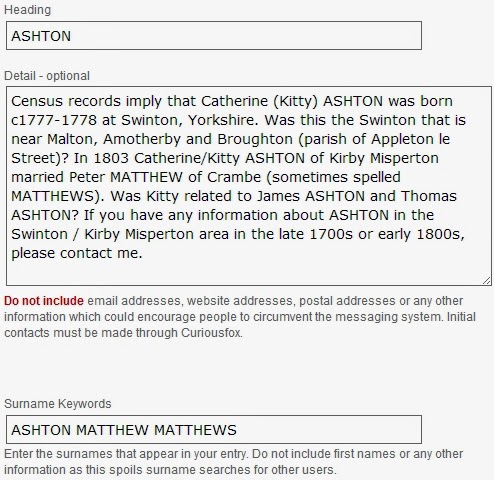
Entry screen for my ASHTON message
HINTS:
  • Give some thought to the wording of your entries. They should be concise, with surnames (and only surnames) in capital letters. Specify dates, and use appropriate punctuation.

  • For large towns with many entries and multiple pages, delete your entry every year and immediately resubmit it (updated if necessary) so that it reappears near the top of the list for that town. I did this recently, and within 24 hours a local historian contacted me and offered to send transcriptions of land records for that surname/town!

I hope you will try Curious Fox and share your success stories in a comment here.

(This is an updated version of a post that originally appeared on http://uk-australia.blogspot.com/2010/08/curiousfox-follow-friday.html for 'Follow Friday', a theme used by 'Geneabloggers'. I also published it on http://worldwidegenealogy.blogspot.com/2014/08/curiousfox-gazetteer-and-message-system.html.)

22 November 2013

FindMyPast or a Coffee?

I recently wrote about why I like using FindMyPast. My world subscription is through their UK site, but I have also registered (free) with the Australia / NZ site because I want to receive their newsletter. (In 'My account - Personal details', tick the box beside 'Please send me an occasional newsletter'.)

The newsletter often has competitions and special offers (discounts, free pay-as-you-go credits, etc). Today's newsletter offered 20% off subscriptions if you join by 30 Nov 2013.

Depending on which subscription you choose, the cost (without discounts) ranges from about $5 to $25 per month. In other words, going without one takeaway coffee per month would save you almost enough to pay for an Australia/NZ subscription. Most people reading this blog probably have British ancestry, and for you the Britain & Australia/NZ subscription may be better value. I chose a world subscription because some branches of my family were in Ireland and Canada.

Not sure whether they have records that will be useful to you? Have a look at the full list (worldwide). More datasets are added each month. Note the inclusion of the British Newspaper Archive and various other digitised newspapers.

If you are thinking about getting a FindMyPast subscription (or if you already have one), see my tips on using FindMyPast for genealogy.

20 July 2013

Three new indexes on FindMyPast

Biographical details of more than 16,000 people, many of them from overseas and other Australian States, are in these three series of historical records at Queensland State Archives - and the names and exact source references are now on FindMyPast.

  • Applicants for the old age pension (Qld) 1908-1909
  • Croydon Hospital (Qld) admission registers 1888-1925
  • Brisbane Hospital (Qld) patient records for part of 1887, 1900, 1901 and 1902

The hospital records usually give details similar to those on a (very informative) Queensland death certificate, plus ship of arrival, place of residence, marital status, father's present residence, and sometimes other information that is very useful for family history. Details provided by a patient at the time of admission are usually more accurate than those on a death certificate.

During the early years of the Croydon gold rush, 70% of patients admitted to the local hospital were born in Britain or Ireland, and about 15% were born in Australia's southern states, especially the Victorian gold-fields.

The old age pension records give information about people who received the pension and also those who were rejected. These registers give the place of residence of many people who were not on electoral rolls, including some who were not British subjects, not naturalised and thus not eligible to vote.

My Web site lists (on separate pages) the names from these three indexes. You may find it more convenient to search or scroll through all 16,200 names in a combined alphabetical list.

If you use FindMyPast to get exact source references, you can personally inspect the original documents at the Archives, or order a copy.

You may be surprised at what you find in these records, which have allowed many people to make rapid progress with their family history. Even if you are not aware of a Queensland connection, I urge you to check the indexes.

Revenue from ads goes to Kiva

04 July 2012

G is for Gypsies, GENUKI and Gold Coast

I was eight weeks late starting the the 'Family History Through the Alphabet' challenge, but I am determined to catch up! Here is my contribution to the letter 'G'.

G is for...
  • Gypsies.  The Romany and Traveller Family History Society is dedicated to researching British Romany Gypsy, Traveller and Fairground ancestors.

  • GENUKI.  The huge GENUKI Web site is the best starting point for genealogy in the UK and Ireland.

  • Gold Coast.  Somerville Funerals undertakers records include overseas and interstate residents who died while holidaying on the Gold Coast (Queensland, Australia). The records give name, age, dates of birth/death/burial, where from, cause of death, next of kin and other remarks. Names from 1965-1983 have been indexed by the Gold Coast Family History Society. (This is an extract from the book Specialist Indexes in Australia: a Genealogist's Guide, which is described on my Web site.)

You will find more tips for family history in my other articles in this series. If the information and advice is useful, have a look at this page.

27 June 2010

UK emigrants at Croydon QLD

A study of hospital admission registers for Croydon (Queensland, Australia) in the late 1880s (during the local gold rush) showed that about two-thirds of the hospital patients were born in the UK or Ireland. Significant numbers also came from the Victorian goldfields and other mining areas. The hospital registers are very useful for family history. See the list of patients' names (about 5,000 of them).